Physical Address
8206 Louisiana Blvd NE, Suite A N03815
Albuquerque, NM 87113
United States
Physical Address
8206 Louisiana Blvd NE, Suite A N03815
Albuquerque, NM 87113
United States

Rubbing that knee mid-stride, wondering if it's just aging or something more? Osteoarthritis is probably what you're dealing with—or trying to avoid. It's not a disease you "fight," more like a conversation your body starts when cartilage wears down. I've watched it unfold in family, friends, my own joints. Understanding what's actually happening, why it develops, and what slows it down changes everything. Not about accepting decline—about slowing it and maintaining function as long as possible.
Ever catch yourself rubbing that knee mid-stride, wondering if it’s just normal aging or something more concerning? Maybe your hands feel stiff when you wake up, or stairs that used to be easy now make your joints complain.
Osteoarthritis is probably what you’re dealing with, or what you’re trying to avoid. It’s the most common form of arthritis—affecting over 30 million Americans—and it’s fundamentally different from other joint problems in ways that matter for how you approach it.
I’ve watched osteoarthritis unfold in family members, friends, and my own joints after years of repetitive stress and poor movement patterns. What I’ve learned is that it’s not a disease you “fight” in the traditional sense. It’s more like a conversation your body starts when cartilage begins wearing down and bones start adapting to new stress patterns.
Understanding what osteoarthritis actually is, why it develops, and what influences its progression changes how you respond to it. This isn’t about accepting inevitable decline. It’s about understanding the process well enough to slow it, manage symptoms effectively, and maintain function for as long as possible.
Let’s break down what you actually need to know.
Osteoarthritis is fundamentally about cartilage breakdown. But it’s not just simple wear and tear like tires on a car—it’s more complex and more responsive to intervention than that analogy suggests.
Healthy cartilage is smooth, slick, and resilient. It cushions the ends of bones where they meet in joints, allowing smooth, low-friction movement. This cartilage has no blood supply and gets its nutrition from synovial fluid through compression and release as you move.
In osteoarthritis, this cartilage gradually becomes rougher, thinner, and less effective at cushioning. Small pieces can flake off. Eventually, in severe cases, cartilage can wear away completely in some areas, leaving bone rubbing directly on bone.
But cartilage loss isn’t the whole story. Your body responds to this damage in ways that create additional problems. The underlying bone thickens and forms spurs (osteophytes) at joint margins. The synovial membrane lining the joint can become inflamed, producing excess fluid that causes swelling. Ligaments may stretch or weaken, reducing joint stability.
This is why osteoarthritis isn’t just mechanical wear—there’s an inflammatory component that matters significantly. The inflammation isn’t as aggressive as rheumatoid arthritis, but it’s real and it contributes to pain, swelling, and further cartilage damage.
The process usually develops slowly over years. It starts in one area of the joint where stress is highest, then gradually spreads. Some people progress quickly, others very slowly. Understanding what drives that variation is key to managing it.
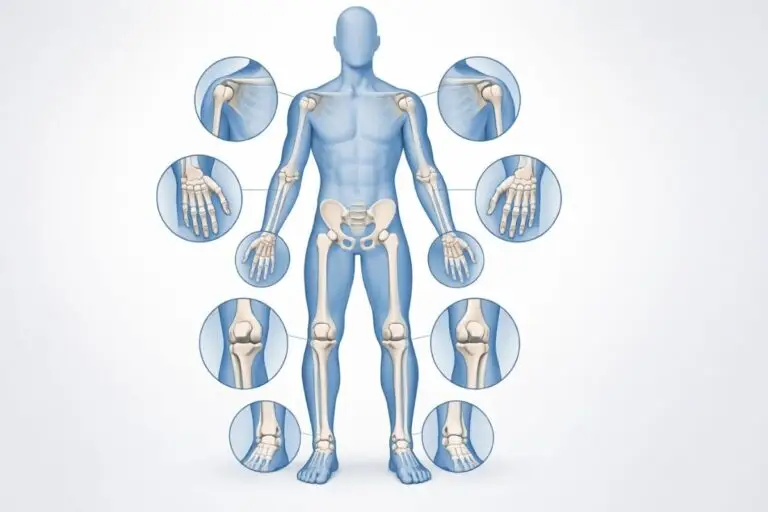
Osteoarthritis preferentially affects certain joints, and the pattern tells you something about causes.
Knees are the most commonly affected major joint. They bear your full body weight with every step, multiplied several times during activities like climbing stairs or squatting. Knee osteoarthritis often develops in people who are overweight, have had previous knee injuries, or have alignment issues that create uneven stress distribution.
I see this constantly—people with slight misalignments who’ve been walking with those patterns for decades. One side of the knee cartilage wears faster than the other. Eventually, pain develops, usually on the inner knee first. The joint space narrows on X-rays, bone spurs form, and function gradually declines.
Hips are the second most common site. Hip osteoarthritis often has a stronger genetic component than knee OA. It can also develop after hip injuries, from developmental abnormalities, or from years of repetitive stress in certain positions. People who sit extensively with poor hip mobility often develop hip OA over time.
Hands are interesting because hand osteoarthritis runs in families and affects women more than men. It typically shows up in the finger joints—the ones closest to your fingertips and the base of your thumbs. You’ll see bony enlargements (Heberden’s and Bouchard’s nodes) and gradual loss of grip strength.
Spine osteoarthritis affects the facet joints between vertebrae and the discs. This is what contributes to age-related back pain and stiffness. Spinal OA often develops from years of poor posture, repetitive movements, or previous injuries.
Other joints can be affected—ankles, shoulders, elbows—but usually there’s a history of injury or overuse in those cases. Primary osteoarthritis rarely hits these joints without a clear reason.
The pattern matters because it points toward causes you might be able to address.
Osteoarthritis isn’t random bad luck, though it can feel that way. Multiple factors contribute, some you can’t control and some you can.
Age is the strongest risk factor. Cartilage naturally becomes less resilient over time, repair mechanisms slow down, and accumulated microtrauma adds up. But age alone doesn’t cause OA—plenty of 80-year-olds have minimal arthritis, and some 40-year-olds have significant disease.
Genetics matter. If your parents had osteoarthritis, particularly in hands or hips, your risk is higher. Certain genetic variations affect cartilage composition and repair capacity. You can’t change your genes, but knowing your family history helps you take preventive steps earlier.
Alignment issues are hugely underappreciated as OA drivers. Flat feet that roll inward, one leg slightly shorter than the other, knocked knees or bow legs—these create uneven stress distribution across joints. Over years and decades, the areas bearing extra load wear down faster.
I’ve seen this in my own body. An old ankle injury that I never properly rehabbed created a chain reaction up my leg. My foot didn’t push off correctly, which changed how my knee tracked, which affected my hip. Years later, that knee started complaining. The osteoarthritis that developed wasn’t just from “wear and tear”—it was from abnormal stress patterns stemming from that initial injury.
Previous injuries dramatically increase OA risk in the affected joint. A torn meniscus, ACL injury, or even a bad ankle sprain that doesn’t heal completely changes joint mechanics and often leads to osteoarthritis 10-20 years later. This is called post-traumatic osteoarthritis, and it’s increasingly common with youth sports injuries.
Weight matters for load-bearing joints. Every pound of excess body weight multiplies the force on your knees and hips with each step. Losing even modest amounts of weight—10-15 pounds—can significantly reduce pain and slow progression in knee and hip OA.
Metabolic factors are increasingly recognized. Type 2 diabetes, metabolic syndrome, and chronic low-grade inflammation from poor diet or gut issues appear to increase OA risk independently of weight. The systemic inflammation affects cartilage health throughout the body.
Movement patterns and posture accumulated over years shape where OA develops. Sitting 10 hours daily with tight hip flexors and forward head posture creates stress patterns that contribute to spinal and hip OA. Repetitive movements from jobs or sports create localized wear.
I’ve watched weekend warriors with good daily movement habits maintain healthy joints into their 70s, while office workers who are sedentary all week develop significant OA by their 50s despite being “careful” with their joints. The body needs regular, varied movement—not rest—to maintain joint health.
The symptoms of osteoarthritis have a particular character that distinguishes them from other joint problems.
Pain is typically worse with use and better with rest, especially early in the disease. Your knee hurts going down stairs but feels okay sitting. Your hands ache after typing or gripping tools but feel fine in the morning. This mechanical pain pattern contrasts with inflammatory arthritis, where pain and stiffness are often worse at rest and improve with movement.
As OA progresses, the pattern can shift. You might develop pain at rest, especially if inflammation becomes more prominent or if the joint deteriorates significantly.
Morning stiffness happens but usually resolves within 30 minutes of moving around. If stiffness lasts an hour or more, that suggests more inflammatory arthritis rather than pure osteoarthritis.
Crepitus—that grinding, crunching, or popping sensation—is common. You might hear or feel your knee creak going up stairs. Your shoulder might click during certain movements. This isn’t necessarily painful, but it’s a sign that joint surfaces aren’t smooth anymore.
Reduced range of motion develops gradually. Your knee doesn’t fully straighten. Your hip won’t lift your leg as high. Your fingers don’t fully close into a fist. This happens because of cartilage loss, bone spurs, muscle tightness, and changes in joint capsules.
Swelling occurs, particularly after activity. Your knee might look puffy after a long walk. Your fingers feel tight after extensive hand use. This swelling is from inflammation in the synovial lining and excess fluid production in response to cartilage damage.
Instability or weakness can develop. Your knee might feel like it could give out. Your hand grip weakens. This comes from muscle wasting around the affected joint, ligament stretching, and altered joint mechanics.
The symptoms usually develop slowly over months to years. Sudden severe pain is more likely an acute injury than osteoarthritis, though OA joints are more vulnerable to additional injuries.
Self-diagnosis of osteoarthritis is tempting but risky. Other conditions can mimic it, and accurate diagnosis matters for treatment.
X-rays are the standard initial imaging. They show joint space narrowing (indicating cartilage loss), bone spurs, and changes in bone density. X-rays are cheap, widely available, and usually sufficient for diagnosis.
The limitation is that X-rays only show bone, not cartilage or soft tissues directly. You’re inferring cartilage loss from the space between bones. Early osteoarthritis might not show on X-rays yet.
MRI provides much more detail. It can show cartilage directly, detect early damage, reveal meniscus tears or ligament injuries, and identify bone marrow edema that indicates active disease. MRI is more expensive and usually reserved for cases where X-rays are unclear or surgery is being considered.
Blood tests don’t diagnose osteoarthritis directly, but they rule out other conditions. Inflammatory markers like CRP and ESR are usually normal or only mildly elevated in OA, unlike rheumatoid arthritis where they’re often dramatically elevated. Specific antibodies (rheumatoid factor, anti-CCP) help distinguish RA from OA.
Physical examination by a knowledgeable doctor or physical therapist reveals a lot. They assess range of motion, check for instability, look for characteristic bony enlargements, test muscle strength, and evaluate movement patterns.
Functional tests matter too. Can you stand on one leg for 30 seconds without wobbling? That tests hip and knee stability. Grip strength measured with a dynamometer shows hand function objectively. These simple tests predict function and track progression better than imaging alone.
The key is getting evaluated when symptoms first develop, not waiting until things are severe. Early diagnosis allows for interventions that genuinely slow progression.
Osteoarthritis is progressive, but the rate of progression is highly variable and influenced by what you do.
Weight loss, if relevant, is probably the single most effective intervention. Every pound lost reduces knee joint forces by roughly 4 pounds during walking. Losing 10 pounds effectively removes 40 pounds of force from your knees with every step. Multiple studies show that even modest weight loss significantly reduces pain and slows cartilage loss in knee and hip OA.
Regular movement is crucial but needs to be the right kind. Joints need loading and motion to stay healthy—immobility accelerates degeneration. But excessive impact accelerates it too.
Walking is usually ideal. It provides moderate loading, moves joints through functional ranges, and is sustainable daily. I aim for 30-60 minutes daily on forgiving surfaces like grass or dirt trails. Pavement is harder on joints but acceptable if it’s what’s available.
Swimming and cycling are good low-impact alternatives, though they don’t provide the weight-bearing stimulus that walking does. A combination works well—walk most days, swim or cycle for additional conditioning.
Strength training is often underutilized but critically important. Strong muscles stabilize joints and reduce the load on cartilage. Quadriceps strength is particularly important for knee OA. Gluteal strength matters enormously for both hip and knee health.
Focus on controlled, moderate-resistance exercises. Wall sits, step-downs, bridges, controlled squats to comfortable depth. You’re building supportive strength, not chasing maximal loads.
I’ve personally felt the difference from consistent strength work. My knee OA symptoms reduced by about 30% after several months of targeted leg strengthening, even though the structural damage on imaging didn’t change. Stronger muscles just distributed forces better.
Alignment correction can be transformative if misalignment is contributing. Orthotics for flat feet, gait retraining, or addressing leg length discrepancies can shift loading patterns and slow progression.
I switched to minimal footwear with zero heel-to-toe drop years ago, which forced better foot mechanics and hip alignment. The change in how my knees felt was significant—less of that grinding sensation, better tracking during movement.
Anti-inflammatory diet and supplements help manage the inflammatory component. Omega-3 fatty acids, curcumin, weight loss, reducing processed foods—these measurably reduce inflammatory markers and often reduce symptoms even if they don’t reverse structural damage.
Activity modification doesn’t mean stopping everything. It means being strategic. If running aggravates your knee, switch to cycling or swimming. If prolonged sitting flares your hip, take frequent movement breaks. Work with your joints, not against them.
Certain interventions are heavily marketed for osteoarthritis despite limited or negative evidence.
Prolonged rest doesn’t help and usually makes things worse. Yes, rest an acutely painful joint for a day or two. But extended rest leads to muscle atrophy, increased stiffness, and faster progression.
Glucosamine and chondroitin have mixed evidence. They help some people with mild to moderate OA, but they’re not miracle cures. If you’ve tried them properly for 3 months without benefit, they’re probably not for you.
Most injections beyond corticosteroids for acute flares have questionable evidence. Hyaluronic acid injections are widely used but studies show minimal benefit over placebo. PRP and stem cell injections are expensive and lack convincing long-term evidence.
Aggressive passive treatments like excessive manual therapy, traction, or elaborate treatment protocols usually don’t address the fundamental problem. They might provide temporary relief but don’t change disease trajectory.
Braces and supports can help acutely but shouldn’t be long-term solutions. They can reduce pain by unloading one part of a joint, but they also allow muscles to weaken. Use them strategically, not constantly.
Joint replacement surgery is remarkably effective when the timing is right. Knee and hip replacements have high success rates for reducing pain and restoring function.
The key is timing. Too early and you’re replacing a joint that could have been preserved longer. Too late and you’ve suffered unnecessarily while muscles have atrophied, making recovery harder.
Generally, consider surgery when: pain significantly limits your daily activities despite conservative treatment, quality of life is genuinely impaired, imaging shows severe joint damage, and you’ve given non-surgical approaches adequate time (usually at least 6-12 months of consistent effort).
Don’t rush into surgery, but don’t wait until you’re barely mobile either. A surgeon who pushes immediate surgery without trying conservative approaches first is suspect. But a doctor who insists you defer surgery indefinitely while you’re miserable isn’t serving you well either.
Arthroscopic surgery for osteoarthritis—cleaning out debris, smoothing cartilage—has largely fallen out of favor. Studies show it’s no better than placebo for most knee OA. It might help if you have a specific mechanical problem like a loose body or meniscus tear, but not for general OA.
Osteoarthritis isn’t curable with current medicine, but it’s highly manageable if you understand it and respond appropriately.
The trajectory isn’t fixed. Two people with identical X-rays can have completely different symptoms and progression rates based on how they move, what they weigh, how they manage inflammation, and how they strengthen supporting structures.
I’ve kept my knee OA relatively stable for five years through consistent movement, strength work, weight management, and biomechanical tweaking. It’s not gone—the cartilage damage on imaging is still there—but it doesn’t limit me significantly.
Your joints signal before crisis. Early stiffness, minor pain with certain movements, occasional swelling—these are opportunities to intervene before things progress.
One practical step this week: assess your alignment and movement patterns. Film yourself walking. Stand on one leg and see how long you can balance. Notice which joints complain during which activities. That information guides what to address first.
Osteoarthritis isn’t just “getting old.” It’s a specific process with specific drivers, many of which you can influence more than you probably realize.
Note: This information is based on current medical understanding and practical experience, not medical advice. If you have joint pain or suspect osteoarthritis, consult with a healthcare provider for proper diagnosis and personalized treatment planning.