Physical Address
8206 Louisiana Blvd NE, Suite A N03815
Albuquerque, NM 87113
United States
Physical Address
8206 Louisiana Blvd NE, Suite A N03815
Albuquerque, NM 87113
United States


Your daily habits shape joint health more than genetics or age. Yet most people never connect how they sleep, sit, and move with the joint pain that shows up later. I've tracked these patterns extensively—the difference between those who maintain function and those who decline comes down to dozens of small daily choices compounded over years. This guide reveals twelve specific lifestyle changes that measurably improve joint health. Not vague wellness advice, but practical modifications that produce real results.
Your daily habits shape your joint health more than genetics, more than age, more than almost anything else. Yet most people never make the connection between how they sleep, sit, stand, and move throughout the day and the joint pain that shows up years later.
I’ve tracked these patterns extensively—in research, in myself, in people I know who’ve either maintained remarkable joint function or progressively declined. The difference rarely comes down to dramatic interventions, but rather the small, consistent behaviors that define truly effective active aging habits after 50. It’s the accumulation of dozens of small daily choices compounded over years.
Most joint health lifestyle advice is vague and useless. “Stay active.” “Reduce stress.” “Get enough sleep.” Sure, but how specifically? What does that look like in real life for someone juggling work, family, and the reality that changing habits is hard?
This guide breaks down twelve specific lifestyle changes that measurably improve joint health. Not aspirational wellness ideals, but practical modifications you can actually implement that produce real results.
Before diving into specific changes, let’s establish why lifestyle matters so profoundly for joint health.
Your joints respond to accumulated stress over time, and those patterns influence how different joint conditions develop, progress, and feel day to day. Sitting in poor posture for eight hours daily creates repetitive stress on your spine. Wearing shoes that change your foot mechanics alters forces up through ankles, knees, and hips. Sleeping in positions that compress joints triggers morning stiffness.
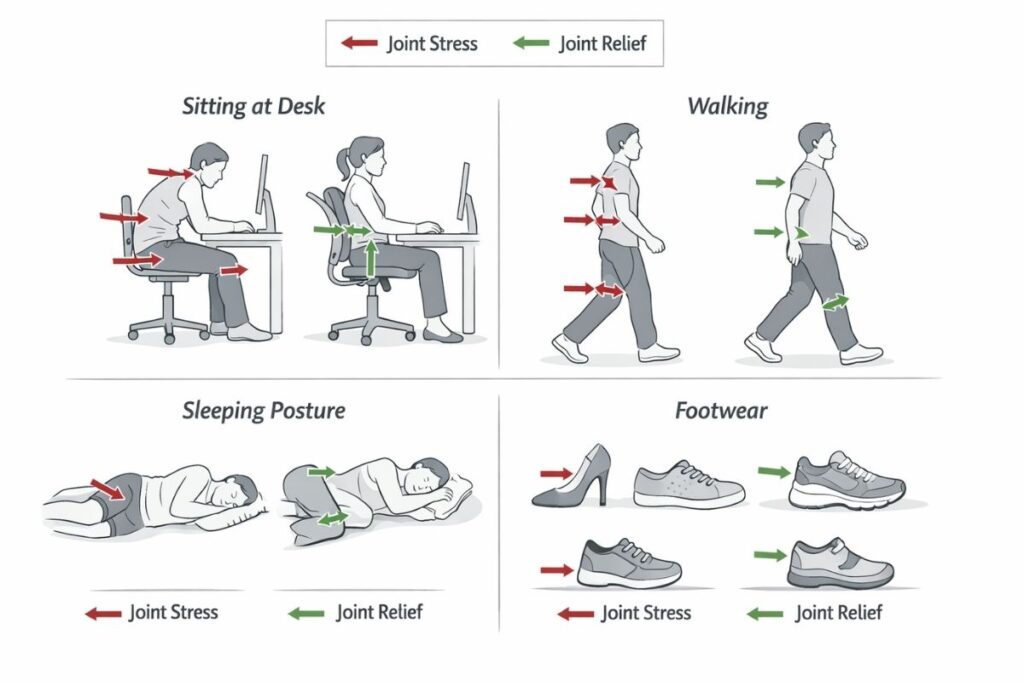
ow daily lifestyle habits affect joint health over timeNone of these cause immediate damage. But repeat them daily for years or decades, and they create the chronic stress patterns that accelerate cartilage breakdown, inflammation, and pain.
The good news: changing these patterns interrupts the accumulation. Small improvements in how you move through daily life reduce joint stress dramatically when compounded over months and years.
These aren’t massive lifestyle overhauls. They’re strategic adjustments to activities you’re already doing—sitting, sleeping, moving around your house, working at a desk. Make them slightly more joint-friendly and the cumulative effect is substantial.
How you sleep affects how you feel in the morning more than almost anything else. Sleep positions create hours of sustained joint loading in specific patterns.
Research from the Arthritis Foundation highlights how sleep positions and joint pain are closely connected, particularly for people with chronic stiffness or arthritis.
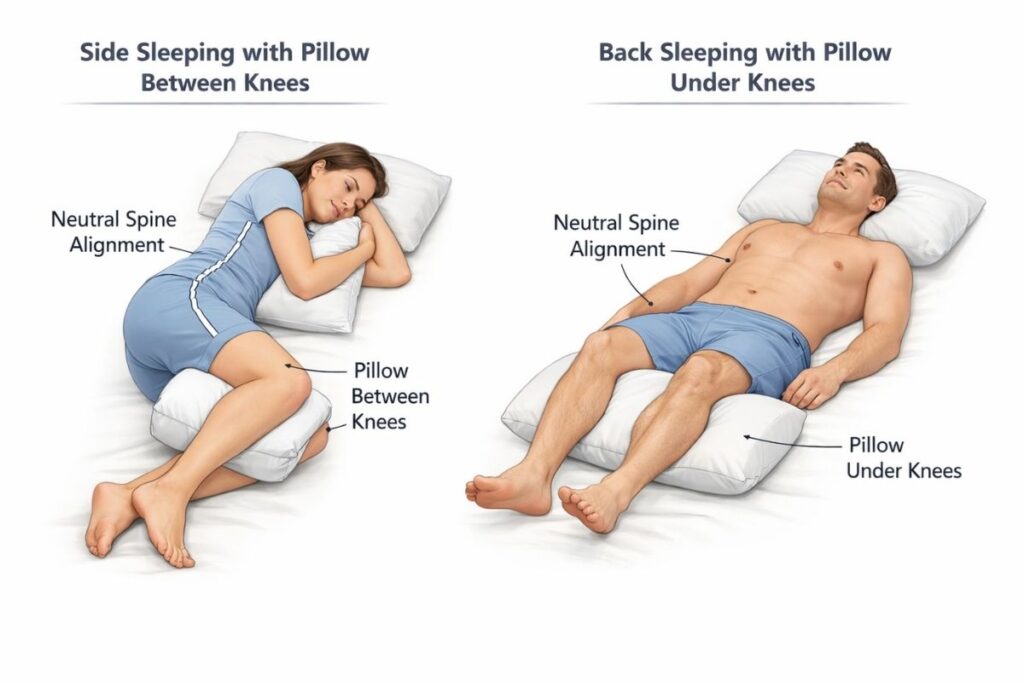
Back sleeping is generally most joint-friendly when done correctly. Place a pillow under your knees to reduce lumbar curve and hip flexor tension. Use a pillow that keeps your neck neutral—not too high, not too flat.
This position distributes weight evenly across your spine and avoids the rotational stress that side sleeping can create. Shoulders and hips aren’t compressed for hours.
Side sleeping can work but requires proper support. Place a pillow between your knees to keep hips aligned and prevent the top knee from pulling your pelvis into rotation. Your bottom shoulder needs sufficient pillow height to prevent compression—your spine should be relatively straight when viewed from behind, not curved downward.
Without the knee pillow, your top leg pulls your pelvis into rotation all night, stressing your sacroiliac joint and lower back. With proper support, side sleeping is perfectly fine.
Stomach sleeping is hardest on joints. Your neck rotates to one side for hours (cervical spine stress), your lower back arches excessively (lumbar stress), and one shoulder typically compresses under body weight.
If you can’t change from stomach sleeping, use a very flat pillow or no pillow to minimize neck rotation, and place a pillow under your hips to reduce lumbar curve.
Practical implementation:
Changing sleep position takes weeks of conscious effort. Your body has established patterns. Use pillows strategically to make better positions comfortable. The knee pillow for side sleepers is non-negotiable—it makes more difference than people expect.
Memory foam or contour pillows maintain neck alignment better than flat pillows for back sleepers. Experiment to find what keeps your neck neutral.
Morning stiffness that improves within minutes suggests your sleep position is contributing. Pay attention to which joints hurt when you first wake—those are likely being stressed during sleep.
If you work at a desk, you’re likely creating repetitive joint stress patterns that accumulate into pain over years.
Monitor position determines neck and shoulder stress. The top of your screen should be roughly at eye level. If you’re looking down at your laptop all day, you’re creating forward head posture that stresses cervical spine, shoulders, and upper back.
Raise your laptop on a stand and use an external keyboard. This single change prevents enormous accumulated stress.
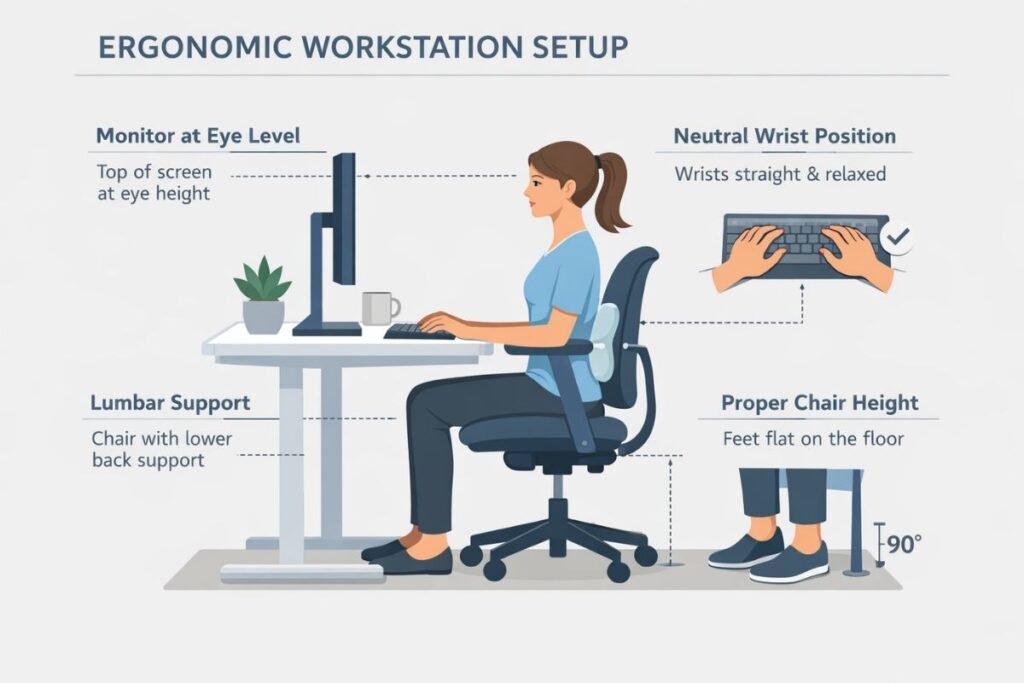
Ergonomic desk setup to protect joint health and postureChair height and back support affect your entire spine and hips. Feet should rest flat on the floor with knees at roughly 90 degrees. Your chair back should support your lumbar curve—most chairs don’t provide adequate support naturally. Add a small lumbar cushion if needed.
Sitting without back support for hours creates slumped posture that loads spinal discs excessively and rounds shoulders forward.
Keyboard and mouse position prevent wrist, elbow, and shoulder stress. Elbows should rest at roughly 90 degrees with forearms parallel to the floor. Reaching forward to keyboard or mouse creates shoulder and neck tension.
Keep keyboard and mouse close enough that your elbows stay near your body. Wrist rests can help maintain neutral wrist position and prevent extension stress.
Standing desk considerations help but aren’t magic. Standing with poor posture is still poor posture. Alternate between sitting and standing throughout the day rather than doing either exclusively.
When standing, keep one foot slightly forward and shift weight between legs periodically. Standing perfectly still for hours stresses ankles and knees differently than walking does.
The hourly movement principle:
No position is perfect for hours continuously. Set a timer for 50 minutes of work, then stand, walk briefly, and stretch for 10 minutes before sitting again. This interrupts accumulated stress and prevents the stiffness that comes from static positions.
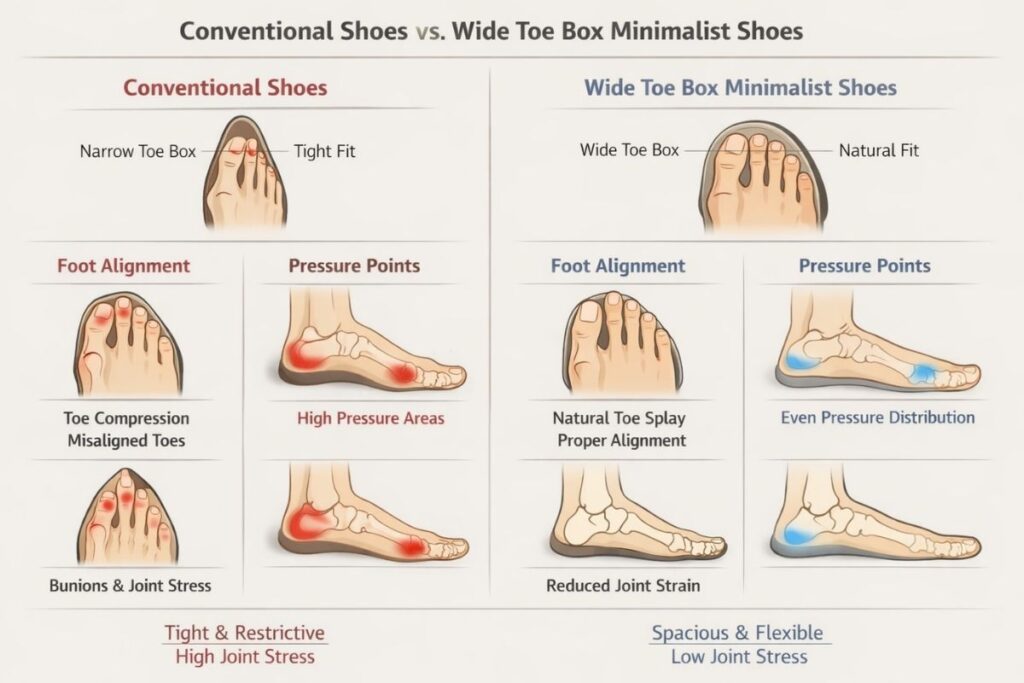
Footwear choices that support joint health and natural movementShoes might seem minor but they fundamentally alter forces traveling through your entire lower body with every step, directly affecting knee stability and alignment over time.
The problem with conventional shoes:
Elevated heels (even the small heel-to-toe drop in most athletic shoes) change your entire biomechanics. They shorten hip flexors, increase anterior pelvic tilt, increase knee flexion during walking, and alter how forces distribute through your feet.
Thick cushioning reduces sensory feedback from your feet. Your brain receives less information about ground contact, balance, and foot position. This reduces coordination and can contribute to poor movement patterns.
Narrow toe boxes squeeze toes together, preventing them from spreading naturally for stability. Weak, cramped feet provide poor foundation for everything above.
Better footwear for joint health lifestyle:
Minimal shoes with low or zero heel-to-toe drop keep your body in more natural alignment. Your feet contact the ground more naturally and muscles work as they evolved to.
Wide toe boxes allow toes to spread for balance and push-off. Your feet actually function rather than being passively contained.
Flexible soles allow your foot to bend and adapt to ground variations rather than forcing rigid motion patterns.
Transition cautiously:
If you’ve worn conventional shoes for decades, switching abruptly to minimal footwear can cause problems. Your feet and lower legs have adapted to passive support. They need time to strengthen.
Start by wearing minimal shoes for short periods—around the house, short walks—and gradually increase duration over weeks and months. Your feet will adapt but they need progressive stimulus.
Walking barefoot at home accelerates this adaptation. Grass, sand, and varied surfaces are ideal when available.
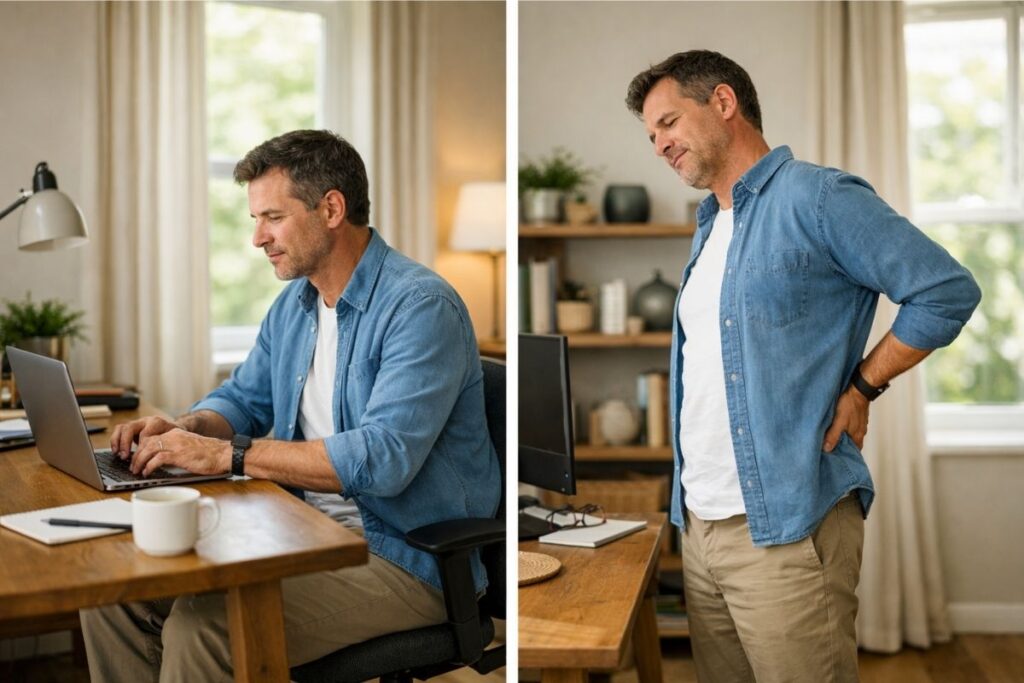
Daily movement habits that improve joint health at homeProlonged sitting is one of the worst things for joint health, but most modern jobs require it. The key is making sitting less destructive.
Harvard Health has extensively documented the effects of prolonged sitting on musculoskeletal health and chronic pain.
The sitting-movement balance:
You can’t avoid sitting entirely, but you can interrupt it regularly. The research shows that breaking up sitting with brief movement intervals prevents many of the negative effects, especially when combined with joint-friendly exercise strategies that strengthen and protect supporting muscles.
Stand and walk for five minutes every hour. This isn't optional—set alarms, schedule it, make it non-negotiable. Those five-minute breaks prevent the hip flexor shortening, glute weakening, and spinal stiffness that accumulate from continuous sitting.
Active sitting strategies:
Sit at the edge of your chair occasionally, engaging core muscles to maintain upright posture without back support. This builds strength and prevents complete reliance on passive support.
Shift positions frequently. Cross legs, uncross legs, sit forward, sit back. Static positions for hours are the problem—varied positions reduce accumulated stress on any single structure.
Use a wobble cushion or balance disc occasionally. These require active muscle engagement to maintain position, turning sitting into light exercise.
Standing alternatives:
Stand for certain tasks—phone calls, reading, reviewing documents. Alternate between sitting and standing throughout the day.
Walking meetings when possible combine movement with necessary discussions. Many conversations happen just as effectively while walking as while sitting in a conference room.
Hydration affects joint health more directly than most people realize.
Synovial fluid—the lubricant in your joints—depends on adequate hydration. Dehydrated joints feel stiffer and move less smoothly. Cartilage quality degrades when chronically dehydrated.
Intervertebral discs in your spine are particularly affected. They’re mostly water, and dehydration reduces their ability to absorb shock and maintain spacing between vertebrae.
How much water for joint health:
General guidelines suggest half your body weight in ounces daily. A 180-pound person needs roughly 90 ounces (about 11 cups). More if you’re active, in hot environments, or sweating significantly.
Mayo Clinic notes that proper hydration and joint health are closely linked through cartilage function and synovial fluid quality.
Coffee and tea count toward hydration despite being mild diuretics. The water content outweighs the diuretic effect for moderate consumption.
Practical hydration habits:
Drink water first thing in morning—you wake dehydrated from hours without fluid intake. Starting with 16-20 ounces rehydrates tissues including joint structures.
Keep water accessible throughout the day. A bottle at your desk, in your car, in your bag. Visual reminders work better than relying on thirst.
Front-load hydration earlier in the day to avoid nighttime bathroom trips disrupting sleep. Most intake should happen before dinner.
Monitor urine color as feedback. Pale yellow suggests adequate hydration. Dark yellow indicates you need more water.

Stress management and recovery techniques for joint healthChronic stress affects joint health through multiple pathways most people never connect.
The stress-inflammation-pain connection:
Stress elevates cortisol and inflammatory cytokines, worsening inflammation and joint pain throughout the body. These circulate throughout your body, increasing inflammation in joints and lowering pain tolerance. The same joint damage feels more painful when you’re stressed than when you’re calm.
According to Cleveland Clinic, chronic stress and inflammation are deeply connected and can significantly worsen joint pain over time.
Stress also changes movement patterns. Tense muscles, shallow breathing, and protective postures during stress create biomechanical patterns that stress joints differently.
Sleep quality suffers under chronic stress, which further impacts joint health through the mechanisms we’ve discussed.
Effective stress management for joint health lifestyle:
Find what actually reduces your stress—not what you think should work, but what actually does. Meditation, therapy, time in nature, exercise, creative activities, social connection—whatever genuinely helps.
Schedule stress reduction the way you schedule work meetings. It’s not optional self-care fluff; it’s joint health medicine with measurable physiological effects.
Address stressors where possible rather than just managing stress reactivity. If your job creates chronic stress, consider whether changes are possible. Some stressors are modifiable; managing them beats endless coping with unchangeable situations.
Physical practices like deep breathing, progressive muscle relaxation, or gentle yoga reduce the physical manifestations of stress that directly affect joint tension and pain.
Hours spent driving or commuting create sustained postural stress on joints.
Car seat position affects spine and hip health:
Seat should position you upright with lumbar support, not reclined like a lounge chair. Many people drive with seats too reclined, creating sustained flexion stress on the lumbar spine.
Headrest should support your head in neutral position, not push it forward. Forward head position during long drives creates enormous neck strain.
Steering wheel distance matters. Reaching forward for the wheel rounds shoulders and creates upper back and shoulder stress. Adjust seat forward enough that elbows stay relatively close to your body.
Break up long drives:
Stop every 90 minutes minimum for extended drives. Walk around, stretch, move your body through different positions. Static sitting in a car is even worse than office sitting because of sustained vibration and limited movement options.
Use these breaks for hip flexor stretches, shoulder rolls, spinal rotations—movements counteracting the driving position.
Commute alternatives:
Walking or cycling for commutes under a few miles provides movement instead of sitting. This is one of the easiest ways to build daily exercise into your routine.
Public transportation allows standing, walking to stops, and movement during the commute rather than static sitting in a car.
How you carry bags, groceries, children, and other loads throughout the day creates repetitive stress patterns.
Asymmetric loading problems:
Carrying a bag on the same shoulder every day creates imbalanced stress—one shoulder elevated, spine curved to one side, hip jutted out for counterbalance. Repeat this daily for years and you develop chronic patterns of muscle tension and joint stress.
Heavy purses or laptop bags on one shoulder pull your body into compensation patterns that stress neck, shoulders, and spine.
Better carrying strategies for joint health:
Alternate sides regularly. Train yourself to switch which shoulder carries your bag. It feels weird initially but prevents accumulated asymmetric stress.
Backpacks distribute weight symmetrically when worn on both shoulders. Use both straps, not one shoulder slung style.
Keep carried weight minimal. Edit bag contents regularly. Every unnecessary pound creates accumulated stress over thousands of carrying episodes.
Hand-held loads should be balanced when possible—grocery bags split between both hands rather than all in one hand.
When lifting and carrying heavier objects, use proper mechanics: bend at hips and knees, keep load close to body, engage core, lift with legs not back.
Your home environment either encourages or discourages movement that supports joint health.
Reduce convenience that eliminates movement:
Sitting to put on shoes eliminates the balance and hip mobility challenged by standing to dress. Consider standing sometimes.
Remote controls mean never standing to change channels. Small, but symbolic of how modern convenience eliminates incidental movement.
Elevators and escalators replace stairs. Taking stairs whenever feasible adds movement to daily routine.
Add movement opportunities:
Keep exercise equipment visible and accessible. Resistance bands on a hook, foam roller in the living room, dumbbells by your desk—visible reminders prompt usage.
Create standing stations for certain activities. A kitchen counter height surface for reading or computer work allows standing options.
Floor-sitting occasionally requires getting up and down repeatedly, which maintains hip mobility and leg strength. Having comfortable floor seating options encourages this.
Design for less sitting:
Arrange furniture so you need to stand and walk between areas rather than reaching everything from one seated position.
Remove or reduce extremely comfortable seating that encourages hours of immobile sitting. Slight discomfort prompts position changes and movement.
Heat and cold are free, accessible tools for managing joint stress and inflammation when used strategically.
Heat before activity:
Warming stiff joints before movement improves comfort and function. Heat increases blood flow, relaxes muscles, and makes joints feel less stiff.
Morning hot showers targeting stiff joints reduce that “creaky” feeling many people experience upon waking. Focused heat on knees, hips, hands, or wherever you feel stiff prepares joints for movement.
Heating pads for 10-15 minutes before exercise or challenging activities can significantly improve how joints feel during those activities.
Cold after inflammation:
Ice after activities that cause joint swelling helps control inflammation. Twenty minutes of ice on a swollen knee after a long walk reduces the inflammatory response.
Cold is most effective immediately after inflammatory stimulus. Waiting hours reduces effectiveness.
Contrast therapy—alternating heat and cold—can be effective for some people, though evidence is mixed. Experiment to see if it helps your specific joints.
Important caveats:
Don’t use heat on acutely inflamed, hot, swollen joints. Heat increases inflammation in these cases. Use ice instead.
Don’t ice immediately before activity—cold temporarily reduces joint proprioception and can increase injury risk. Heat before, cold after.
Phone, tablet, and computer use creates specific repetitive stress patterns affecting neck, shoulders, hands, and wrists.
Phone posture devastates neck health:
Looking down at your phone for hours daily creates enormous stress on cervical spine. Your head weighs 10-12 pounds. For every inch forward it moves, the force on your neck muscles and vertebrae increases by roughly 10 pounds.
Looking down 60 degrees at your phone creates about 60 pounds of force on your neck. Repeat this for hours daily and chronic neck pain is almost inevitable.
Better phone habits:
Raise your phone to eye level rather than looking down. This feels awkward initially but prevents accumulated neck stress.
Limit continuous phone time. Set timers for 15-20 minute intervals, then put the phone down and look around, stretch your neck, change position.
Use voice features instead of typing when possible to reduce hand and wrist stress from texting.
Computer work considerations:
External monitors at proper height prevent laptop-induced neck flexion. This single change prevents enormous accumulated stress.
Ergonomic keyboards and mice reduce wrist extension and deviation stress. If you type extensively, proper input devices matter significantly.
Take regular visual breaks from screens. The 20-20-20 rule: every 20 minutes, look at something 20 feet away for 20 seconds. This also prompts position changes.
Most people ignore early warning signs until problems become significant. Regular self-assessment catches issues when they’re still easily addressed.
Weekly check-ins:
Notice which joints feel stiff or uncomfortable. Patterns reveal which activities or positions are creating stress.
Assess range of motion—can you still touch your toes, reach overhead comfortably, squat to parallel? Declining range signals problems developing.
Notice sleep quality and morning stiffness patterns. Changes often correlate with lifestyle factors you can modify.
Monthly reviews:
Evaluate whether pain levels are improving, stable, or worsening. Stable or improving suggests your joint health lifestyle changes are working. Worsening means something needs adjustment.
Check strength markers—can you still do activities that were manageable before? Declining function signals need for intervention.
Review adherence to the lifestyle changes you’ve implemented. Which ones have become habits? Which ones keep slipping?
Quarterly deeper assessment:
Consider whether professional evaluation might help—physical therapy assessment, movement screening, targeted testing.
Review whether your current approach is working well enough or needs modification based on results.
Adjust your joint health lifestyle strategy based on accumulated experience about what works for your specific body and circumstances.

Building a sustainable joint health lifestyle through daily habitsThese twelve changes work synergistically. Implementing all of them simultaneously is overwhelming. Strategic prioritization works better.
Start with highest impact changes for your situation:
If you sit at a desk eight hours daily, desk setup and hourly movement breaks are critical.
If you wake with morning stiffness, sleep position and hydration are priorities.
If you commute long distances, driving position and commute breaks matter most.
Build habits progressively:
Choose one or two changes to implement first. Spend two to three weeks establishing those as habits before adding more.
Use implementation intentions: “When I sit at my desk, I will set a timer for 50 minutes.” Specific triggers help habits stick.
Track adherence simply—checkmarks on a calendar for completed behaviors. Visual feedback reinforces habit formation.
Adjust based on results:
If a change produces noticeable improvement, maintain it permanently. If you try something for a month without benefit, modify or replace it.
Individual responses vary. What works remarkably well for one person might be less effective for another. Pay attention to your results, not just general recommendations.
The goal is building a sustainable joint health lifestyle that works for your real life, not following a perfect protocol you can’t maintain.
These twelve lifestyle changes represent accumulated wisdom from research, clinical experience, and real-world testing. None are dramatic. All are implementable. Together, they create enormous cumulative benefits for joint health when maintained consistently over months and years.
Your daily habits determine your long-term joint health more than any other factor. Choose them wisely.
Note: This is educational information about lifestyle factors affecting joint health, not medical advice. Consult with qualified healthcare providers for diagnosis and treatment of specific joint conditions.